Baked Pears with Cranberries and Honey: A Perfect Fall Dessert Recipe That Feels Like a Warm Hug
There is something truly magical about the aroma of baked fruit filling your kitchen on a cool autumn evening. This Baked Pears with Cranberries and Honey recipe captures that feeling perfectly, offering a dessert that feels both luxurious and wonderfully simple. The natural sweetness of ripe pears melds beautifully with tart cranberries, while a generous drizzle of honey adds a floral, golden richness that ties every bite together. You do not need to be a professional pastry chef to create this stunning dish, and the result is a dessert that impresses guests and comforts family members alike.
The combination of textures in this Baked Pears with Cranberries and Honey recipe is what truly sets it apart. As the pears soften in the oven, they become tender and buttery, offering a melt-in-your-mouth quality that contrasts perfectly with the burst of tartness from the cranberries. The honey caramelizes slightly around the edges, creating a sticky, luscious syrup that coats the fruit beautifully. To add an extra layer of complexity, we introduce crunchy walnuts and creamy, tangy blue cheese. The walnuts provide a satisfying crunch, while the blue cheese offers a savory, salty counterpoint that balances the sweetness of the honey and pears.
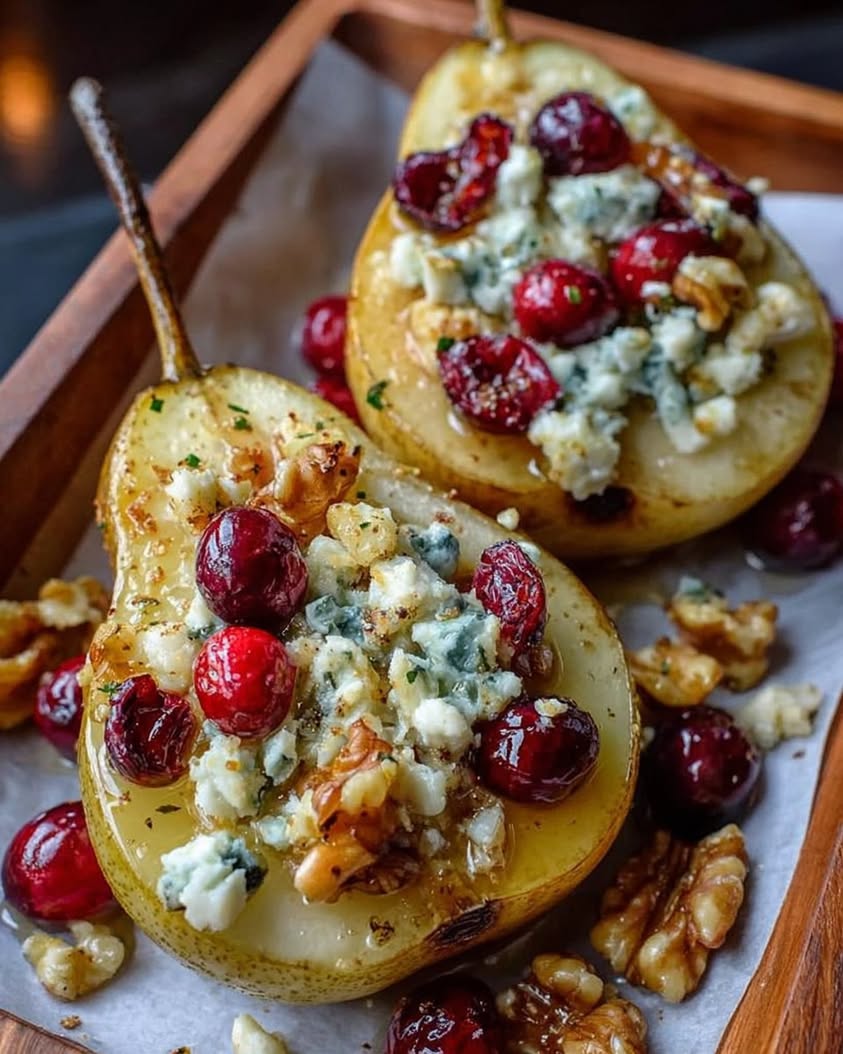
This dessert is remarkably versatile, making it an ideal choice for a weeknight treat or a special holiday gathering. It comes together with minimal effort, requiring only a few minutes of preparation before the oven does most of the work. Whether you are looking for a healthier alternative to heavy cakes and pies or simply want to showcase the beauty of seasonal produce, this Baked Pears with Cranberries and Honey recipe will quickly become a favorite. The visual appeal is undeniable, with deep red cranberries nestled against golden pears, all finished with a sprinkle of toasted walnuts and crumbled blue cheese. It is a dessert that looks as wonderful as it tastes.
Quick Recipe Highlights
- Flavor Profile: This dessert offers a masterful balance of sweet honey, tart cranberries, and savory blue cheese. The natural sugar in the pears intensifies during baking, creating a rich, caramel-like sweetness.
- Texture: You get a wonderful contrast between the soft, tender baked pears and the juicy pop of the cranberries. The toasted walnuts add a coarse crunch, while the blue cheese melts slightly into a creamy, luxurious finish.
- Aroma: The scent of warm honey and baked pears fills your home with a cozy, inviting fragrance. As the cranberries burst, they release a bright, fruity note that is beautifully complemented by the earthy aroma of toasted walnuts.
- Visual Appeal: The presentation is naturally stunning, featuring golden-brown pears dotted with bright red cranberries. A final sprinkle of crumbled blue cheese and chopped walnuts creates a beautiful rustic look that is perfect for any table.
- Skill Level Needed: This recipe is ideal for beginners, requiring only basic knife skills and the ability to bake. There are no complex techniques, making it a stress-free and rewarding dessert project.
- Special Equipment: You will need a sharp knife for halving the pears and a small baking dish. A melon baller or small spoon is useful for coring, but not strictly necessary.
Recipe Overview
- Difficulty Level: This recipe is classified as easy due to its straightforward steps and forgiving nature. You do not need to worry about precise timing, as the pears can be baked to your desired level of softness. The ingredients are simple, and there is no need for any special pastry skills.
- Category: This dish fits perfectly into the dessert category, but it also works wonderfully as a brunch item or a light snack. It is sweet enough to satisfy a sugar craving, yet it is not overly heavy or cloying.
- Cuisine: The culinary influences here are a blend of rustic American and French countryside traditions. The use of pears, honey, and walnuts is deeply rooted in European cooking, while the addition of cranberries gives it a distinctly North American touch.
- Cost: This is a very affordable dessert, especially when pears and cranberries are in season. The ingredients are common and easy to find, and the portion sizes mean that a little goes a long way. Using bulk walnuts and a basic honey will keep costs low.
- Season: This recipe is at its absolute best from early autumn through the winter months. This is when pears are at their peak of ripeness and cranberries are widely available, making the flavors incredibly fresh and vibrant.
- Occasion: This dessert is perfect for a cozy family dinner, Thanksgiving, a holiday party, or even a romantic date night at home. It feels special enough for a celebration but is simple enough for a casual weeknight meal.
Why You’ll Love This Recipe
The first reason you will fall for this recipe is the incredible taste and texture contrast. When you take a bite, the soft, warm pear gives way to a burst of tart juice from a cranberry, all wrapped in a sweet honey glaze. This combination is immediately followed by the rich, creamy tang of the blue cheese and the satisfying crunch of the toasted walnuts. Each forkful offers a new, delightful experience that keeps you coming back for more. The flavors meld beautifully, creating a dessert that is complex without being fussy.
Convenience is another major selling point, as this dessert requires very little active work. You only need about fifteen minutes to prepare the pears, and then the oven handles the rest. This leaves you free to prepare the main course or simply relax with a glass of wine. The ingredients are pantry staples, so you can likely make this dessert without a special trip to the grocery store. It is a perfect solution for when you need an impressive dessert but do not have a lot of time or energy.
From a nutritional standpoint, this dessert offers a much healthier profile than traditional baked goods. Pears are an excellent source of dietary fiber and vitamin C, while walnuts provide healthy omega-3 fatty acids and protein. Cranberries are packed with antioxidants, and honey contains beneficial enzymes and phytonutrients. You can feel good about serving this dessert to your family, knowing that it provides real, wholesome nutrition alongside its wonderful flavor.
This recipe is also fantastic for social gatherings and entertaining because it looks so impressive with minimal effort. When you bring a baking dish of these beautiful, honey-glazed pears to the table, your guests will be wowed by the presentation. It is a naturally elegant dessert that does not require any complex plating or garnishing. The combination of colors and textures makes it a conversation starter, and the communal aspect of a baked fruit dessert encourages sharing and togetherness.
Finally, the cost-effectiveness and accessibility of this recipe make it a clear winner. Pears are generally inexpensive, and cranberries can be bought fresh or frozen for a low cost. Walnuts and honey are long-lasting pantry items that you can use in many other recipes. This means you can create a gourmet-tasting dessert for a fraction of the cost of a restaurant meal. It is a smart, budget-friendly choice that never compromises on flavor or quality.
Historical Background and Cultural Significance
The concept of baking fruit is as old as cooking itself, with evidence of baked apples and pears appearing in ancient Roman and Greek culinary texts. The practice of sweetening fruit with honey predates refined sugar by thousands of years, making this dish a direct descendant of some of the oldest dessert traditions in human history. In medieval Europe, pears were often baked in honey and spices for feasts, a tradition that eventually traveled to America with European settlers.
Cranberries hold a special cultural significance in North America, where they are native to the continent. Native American tribes used cranberries for food, medicine, and dye long before the arrival of Europeans. They introduced the fruit to the Pilgrims, and it quickly became a staple ingredient in New England cuisine. The pairing of cranberries with honey reflects a blending of indigenous foodways with European culinary techniques, creating a uniquely American combination.
The addition of walnuts and blue cheese is a more modern evolution of this classic dessert. Walnuts have been grown in California since the 18th century, and their rich, buttery flavor complements the sweetness of baked fruit perfectly. Blue cheese, once considered a luxury ingredient, adds a sophisticated, savory element that elevates the dish from a simple fruit bake to a complex, restaurant-quality dessert. This evolution mirrors the growing trend of combining sweet and savory flavors in modern cooking.
Regional variations of this recipe can be found all over the world. In Italy, bakers might use gorgonzola and pine nuts instead of blue cheese and walnuts. In the Middle East, the honey would often be replaced with date syrup, and the walnuts might be swapped for pistachios. Some French versions use creme fraiche instead of cheese, while a Greek variation might incorporate feta and oregano for a savory touch. This recipe serves as a beautiful canvas for global creativity.
Ingredient Deep Dive
Pears are the star of this recipe, and they have a long, storied history that dates back to prehistoric times. They were cultivated by the ancient Greeks and Romans, who prized them for their sweet flavor and versatility. Nutritionally, pears are an excellent source of dietary fiber, which aids in digestion and helps maintain steady blood sugar levels. They also provide a significant amount of vitamin C and copper, both of which support immune health. When selecting pears for baking, look for fruits that are ripe but still firm, with no soft spots or bruises. Bosc pears are an excellent choice due to their dense flesh and sweet flavor, but Anjou and Bartlett varieties also work well. Store unripe pears at room temperature to ripen, then move them to the refrigerator to extend their shelf life. If you cannot find pears, ripe apples or quinces can be used as a substitute, though the cooking time may need to be adjusted.
Cranberries bring a necessary acidity and bright color to this dessert. Native to North America, cranberries have been used by indigenous people for centuries in pemmican, a high-energy survival food, and as a natural dye. They are celebrated for their high antioxidant content, particularly proanthocyanidins, which are linked to urinary tract health and reduced inflammation. When buying fresh cranberries, look for those that are firm, plump, and a deep red color. Frozen cranberries are a wonderful alternative and are available year-round without sacrificing quality. Store fresh cranberries in the refrigerator for up to two months or freeze them for up to a year. If you need a substitute, dried cranberries reconstituted in hot water can work, or you can use frozen cherries or fresh raspberries for a different flavor profile.
Honey is the sweetener that provides the deep, floral notes in this dish. Humans have been harvesting honey for over 8,000 years, and it has held a sacred place in many cultures as a symbol of abundance and health. Unlike refined sugar, honey contains trace amounts of enzymes, vitamins, and minerals, giving it a small nutritional advantage. It is also a natural antibacterial agent. For this recipe, a milder honey like clover or orange blossom allows the pear flavor to shine, while a stronger honey like buckwheat would overpower the dish. Store honey at room temperature in a sealed container, as refrigeration can cause it to crystallize. If you need a substitute, maple syrup or agave nectar can be used, though they will impart a slightly different flavor.
Walnuts offer a crucial textural crunch and an earthy flavor that anchors the dish. Walnuts are one of the oldest tree foods known to humanity, with evidence of their use dating back 7,000 years. They are exceptionally high in omega-3 fatty acids, specifically alpha-linolenic acid, which is vital for brain health and reducing inflammation. At the store, look for walnuts that are plump and uniform in color, avoiding any that smell musty or rancid. Toasting walnuts before use is a crucial step, as it intensifies their flavor and crispness. Store them in an airtight container in the refrigerator or freezer to prevent them from going rancid. Pecans or almonds would be suitable crunch alternatives.
Blue cheese provides the savory, salty counterpoint that makes this recipe so memorable. Blue cheese originates from caves in France, where mold was accidentally introduced to aging cheese, creating the signature veining. It is a nutrient-dense food, rich in calcium, protein, and probiotics that support gut health. When selecting blue cheese, look for a wedge that is creamy and moist with well-distributed blue veins. Avoid cheese that is hard, dry, or smells strongly of ammonia. Gorgonzola is a milder, creamier option, while Roquefort offers a sharper, more pungent flavor. If you are not a fan of blue cheese, goat cheese or feta can provide a similar tangy, creamy element.
Common Mistakes to Avoid
- Using under-ripe pears is a common error that leads to a hard, starchy texture. The pears will not soften properly in the oven, resulting in a disappointing mouthfeel. Always choose pears that yield slightly to gentle pressure at the stem.
- Overcooking the pears until they become mushy is another frequent problem. You want them to be tender but still hold their shape. Check on them frequently after 20 minutes of baking, as oven temperatures can vary.
- Skipping the toasting of walnuts is a missed opportunity for flavor. Toasting releases their natural oils and deepens their nutty taste dramatically. It only takes a few minutes in a dry skillet and is well worth the effort.
- Using too much honey can result in an overly sweet, cloying dish. The natural sugar from the pears also contributes to the sweetness. Start with the recommended amount and adjust to your taste preference.
- Forgetting to core the pears completely can lead to a gritty, inedible center. The core and seeds are tough and should be removed with a small spoon or melon baller for a pleasant eating experience.
- Adding the blue cheese at the beginning of baking will cause it to melt into a puddle. You want the cheese to soften slightly but remain identifiable. Add it during the last five minutes of baking for the best result.
- Neglecting to leave space between the pears in the baking dish prevents even cooking. The pears need room for the hot air to circulate, which ensures they cook uniformly. Use a dish that fits them in a single layer without crowding.
- Baking the cranberries whole without a small slit can cause them to burst explosively. While this is not a safety risk, it can create a messy dish. A quick poke with a fork prevents this issue.
Essential Techniques
Mastering the art of coring a pear is an essential skill for this recipe. The goal is to remove the tough, fibrous core and seeds while leaving the flesh intact and presentable. To start, cut the pear in half lengthwise from the stem to the bottom. Then, use a small melon baller or a teaspoon to scoop out the core, creating a small, clean well in the center of each half. Do not cut all the way through the bottom of the pear, as you want a small bowl shape to hold the filling. This technique is important because it creates a beautiful pocket for the cranberries and honey, and it ensures that you do not bite into a gritty seed.
Toasting walnuts is a simple but transformative technique that significantly enhances their flavor and texture. The process involves heating the nuts in a dry pan or oven until they become fragrant and lightly browned. This triggers the Maillard reaction, which releases their natural oils and creates a deeper, more complex, nutty flavor. To toast them, place the walnuts in a single layer in a dry skillet over medium heat. Shake the pan frequently and watch closely, as they can burn in seconds. Once they emit a nutty aroma and turn a shade darker, remove them from the heat immediately. This technique is crucial because untoasted walnuts can taste slightly bitter and lack the pleasant crunch that makes this dessert so enjoyable.
Properly drizzling honey is a technique that affects both flavor distribution and presentation. You do not simply want to pour the honey over the pears all at once, as it will pool at the bottom of the dish. Instead, use a slow, steady drizzle in a circular motion to ensure each pear half gets coated. Start at the center of each pear and work your way outward, allowing the honey to flow into the crevices and over the cut surface. This technique is important because it ensures every bite is touched by the honey’s sweetness, and it helps the pears caramelize more evenly during baking. A final drizzle after baking adds a beautiful glossy finish and an extra pop of sweetness just before serving.
Pro Tips for Perfect Baked Pears with Cranberries and Honey
For the best results, choose pears that are ripe but still firm to the touch. If your pears are a bit under-ripe, let them sit at room temperature for a day or two before baking to allow their natural sugars to develop. This will ensure a sweeter, more tender final dessert.
Do not skip the step of gently rubbing the cut sides of the pears with a little lemon juice. This simple trick prevents the pears from oxidizing and turning brown before they go into the oven. It also adds a subtle brightness that balances the sweetness of the honey.
Consider adding a vanilla bean or a cinnamon stick to the baking dish for an extra layer of aromatic flavor. These simple additions infuse the honey syrup with a warm, spicy background note that complements the fruit perfectly. Remove them before serving.
If you want a thicker, more syrupy glaze, you can carefully transfer the pan juices to a small saucepan after baking. Simmer the liquid over medium heat for a few minutes until it reduces and thickens slightly. Drizzle this concentrated syrup over the plated pears for an elegant finish.
For a more dramatic presentation, you can slice the baked pears instead of serving them as halves. After baking, use a sharp knife to cut each pear half into three or four slices, fanning them out on the plate. This creates a beautiful, restaurant-style look.
Always let the pears rest for about five minutes after removing them from the oven. This resting period allows the juices to redistribute and the pears to cool slightly, making them easier to handle and eat. It also prevents the roof of your mouth from getting burned by the hot syrup.
To make this dessert even quicker to prepare, you can use a pre-made honey syrup. Combine equal parts honey and hot water in a small bowl, stir until smooth, and use this mixture to drizzle over the pears. This is especially helpful if your honey has crystallized.
Variations and Adaptations
One of the most popular regional variations of this dish involves using different types of cheese. In Italy, a mild gorgonzola dolce is often used instead of a stronger blue cheese, while some French versions incorporate a creamy roquefort. For a vegetarian and more accessible option, you can crumble a mild feta cheese over the pears, which provides a similar tangy, salty contrast. The texture of the cheese can also be varied, from a creamy, spreadable cheese to a firmer, crumblier one.
Seasonal adaptations are a wonderful way to keep this recipe exciting all year long. In the spring, you can replace the cranberries with fresh raspberries or sliced strawberries. During the summer months, ripe peaches or nectarines can be baked instead of pears, and a drizzle of local wildflower honey adds a beautiful floral note. The walnuts can be swapped for pecans or hazelnuts depending on the season and your personal preference.
Dietary modifications are easy to make with this recipe. To make it dairy-free, simply omit the blue cheese and add an extra sprinkle of toasted coconut or a dollop of coconut cream. For a vegan version, replace the honey with maple syrup or agave nectar, and use a plant-based cheese alternative. A low-carb version can be achieved by reducing the honey or using a sugar-free honey substitute, and by replacing the pears with a low-sugar fruit like apples.
Flavor variations can completely transform the profile of this dessert. Adding a pinch of ground cardamom or allspice to the honey brings a warm, exotic spice note. A few fresh rosemary sprigs placed among the pears during baking infuse the dish with a savory, herbal aroma. For a boozy twist, you can add a tablespoon of brandy or bourbon to the honey mixture before baking.
Texture modifications allow you to tailor the dish to your liking. If you prefer a softer, more compote-like dessert, you can chop the pears into bite-sized cubes before baking and reduce the cooking time. For a crunchier topping, add a streusel made from oats, butter, and brown sugar during the last ten minutes of baking. A drizzle of balsamic reduction after baking adds a tangy, syrupy texture that is wonderful.
Presentation alternatives can make this dish suitable for any occasion. For a family-style dinner, serve the pears directly from the baking dish with a large spoon. For a more formal event, plate each pear half individually on a small plate, drizzled with the pan sauce and garnished with a sprig of fresh thyme. You can also serve the pears over a scoop of vanilla ice cream or alongside a wedge of pound cake.
Serving and Presentation Guide
Plating this dessert is a wonderful opportunity to show off its natural beauty. For a simple, rustic presentation, place one pear half in the center of a shallow bowl or plate. Use a large spoon to drizzle the warm honey-cranberry syrup over the top, allowing it to pool slightly on the plate. Then, scatter a generous pinch of toasted walnuts and crumbled blue cheese right over the center of the pear. This creates a beautiful, inviting look that highlights the key ingredients.
Garnishing ideas can elevate the presentation even further. A single fresh thyme or rosemary sprig placed on top adds a pop of green and a hint of earthy aroma. A light dusting of powdered sugar over the plate, just before serving, adds a touch of elegance and visual contrast. A small dollop of freshly whipped cream or a scoop of vanilla bean ice cream melting into the warm syrups creates a classic pairing that is hard to beat.
Traditional accompaniments for baked fruit desserts include heavy cream or creme anglaise. A light, pourable custard is a wonderful way to balance the sweetness and add a creamy, lush texture to each bite. In some European traditions, a thin slice of butter cake or a crisp tuile cookie is served alongside the baked pears to provide a textural contrast.
Modern serving suggestions are equally appealing. You can serve the baked pears over a bed of arugula for a savory-sweet salad course, or tuck them into a warm crepe for a breakfast twist. They also work beautifully as a topping for oatmeal or yogurt parfaits. The versatility of this dish means it can be adapted to fit almost any part of a meal.
Temperature considerations are key for the best experience. This dessert is best served warm, straight from the oven, when the pears are at their most tender and the syrup is most fluid. However, it is also delicious at room temperature, making it a great option for potlucks or buffets. If you serve it cold, the honey will thicken into a gel, which changes the texture but is still pleasant.
Portion control tips are helpful for managing servings. One pear half is generally a perfect serving size for a rich dessert, but two halves are appropriate for a larger appetite or when serving it as a main course for a light meal. If you are serving a crowd, you can easily scale up the recipe and let guests serve themselves from a large, beautiful baking dish placed in the center of the table.
Wine and Beverage Pairing
When it comes to wine pairings, the sweetness of the honey and pears calls for a wine that can match its intensity. A late-harvest Riesling or a Sauternes is an excellent choice, as these wines are sweet but balanced by high acidity. The acidity helps cut through the richness of the blue cheese and the fat of the walnuts. A German spatlese or auslese is also a wonderful option, offering a lighter, more floral profile that complements the fruit perfectly.
For red wine lovers, a light, fruity red works better than a heavy, tannic one. A chilled Beaujolais Nouveau or a Pinot Noir from a cooler climate offers bright red fruit flavors and low tannins that will not overwhelm the delicate pears. The fruit forwardness of these wines mirrors the cranberries and pears beautifully. A Lambrusco, a slightly fizzy red from Italy, provides a fun, playful pairing that cleanses the palate between bites.
Non-alcoholic alternatives are abundant and delicious. A high-quality sparkling apple cider or a ginger kombucha provides the acidity and fizz needed to balance the rich dessert. A warm, spiced chai tea or a chamomile tea with a touch of honey offers a comforting, cozy pairing that echoes the flavors of the dish. For a simple, elegant option, a glass of cold, unsweetened iced tea with a sprig of mint works surprisingly well.
Coffee and tea pairings are wonderful for this dessert, especially when served after a meal. A dark roast coffee with notes of chocolate or caramel complements the sweetness of the honey and the nuttiness of the walnuts. A chai latte with its blend of cinnamon, cardamom, and ginger adds a layer of spice that enhances the fall flavors. A simple green tea with jasmine offers a light, floral counterpoint that cleanses the palate.
Serving suggestions for beverages are simple but important. If serving wine, make sure it is slightly chilled, even for the red options, as a cooler temperature helps keep the experience refreshing. For non-alcoholic drinks, a frothy, warm latte or a bubbly, cold cider creates a textural contrast that is very enjoyable. Always offer the beverage alongside the dessert, allowing guests to alternate between bites and sips.
Storage and Shelf Life
Storing leftover baked pears properly is important to maintain their quality and safety. First, allow the pears to cool completely to room temperature before placing them in any container. If you store them while they are still warm, condensation will form inside the container, making the pears soggy and diluting the syrup. Once cooled, transfer the pears along with all the pan juices into an airtight container.
Temperature requirements are straightforward for this dessert. Baked pears should be stored in the refrigerator, as the sugar and fruit mixture can spoil if left at room temperature for too long. They will keep well for up to four or five days in the refrigerator. The cold temperature will cause the honey syrup to thicken and become more gel-like, but this is normal and does not affect the taste.
Container recommendations focus on airtight storage. A glass or plastic container with a tight-fitting lid is ideal, as it prevents the pears from absorbing other odors from the fridge. If using a bowl, cover it tightly with plastic wrap, ensuring the wrap touches the surface of the syrup to prevent a skin from forming. Avoid metal containers, as the acidity from the cranberries can react with the metal, altering the flavor.
Signs of spoilage are easy to detect if you know what to look for. The most obvious sign is a sour or fermented smell coming from the dish. If you see any mold growth on the pears or in the syrup, discard the entire batch immediately. A change in texture, such as the pears becoming excessively mushy or slimy, is another indicator that the dessert is past its prime.
Reheating instructions are crucial for bringing the dessert back to life. The best method is to reheat the pears in the oven at 350 degrees Fahrenheit for about 10 minutes, or until they are warmed through. You can also use a microwave, but this can make the pears slightly rubbery. If the syrup has thickened too much, add a splash of hot water and stir gently before reheating.
Freezing guidelines are helpful for long-term storage. Baked pears can be frozen, but the texture will change upon thawing, becoming softer and more watery. If you choose to freeze them, place the cooled pears in a freezer-safe bag, squeeze out all the air, and seal tightly. They will last for up to three months. Thaw them in the refrigerator overnight before reheating gently.
Make Ahead Strategies
A well-planned prep timeline can make this dessert incredibly convenient for entertaining. You can prepare the pears up to two days in advance by coring and halving them, then storing them in a bowl of water with a little lemon juice to prevent browning. The cranberries can be washed and dried, and the walnuts can be toasted and stored in an airtight container. This allows you to assemble the dish in minutes on the day you plan to serve it.
Storage between steps is important to maintain freshness. If you core the pears ahead of time, keep them submerged in the lemon water in the refrigerator. The toasted walnuts should be stored at room temperature in a sealed bag to keep them crisp. The blue cheese can be crumbled and stored in the refrigerator, but wait to add it until just before baking to prevent it from drying out.
A quality impact assessment is necessary when making parts of this dish ahead. The pears will darken slightly even with lemon juice, but this is only cosmetic and does not affect the taste. The walnuts will lose some of their crunch if they are exposed to moisture, so keep them dry. The honey and cranberries should be stored separately, as the cranberries can leach color into the honey if left together for too long.
Assembly tips for make-ahead success focus on efficiency. On the day of service, simply remove the pears from the lemon water, pat them dry, and arrange them in the baking dish. Drizzle with honey and top with the cranberries. You can even do this step a few hours ahead and keep the dish covered at room temperature. Right before baking, add the blue cheese and walnuts for the best texture.
Reheating guidelines for a make-ahead dish are similar to reheating leftovers. If you bake the pears completely and then want to serve them later, simply reheat them in a 350 degree oven for about 15 minutes, or until warmed through. This method ensures the pears stay tender and the syrup becomes fluid again. Avoid using the microwave for reheating a full batch, as it will cook unevenly.
Fresh element additions are a great way to brighten a make-ahead dessert. Just before serving, you can add a final sprinkle of fresh, untoasted walnuts for extra crunch, or a drizzle of fresh honey for a glistening, flavorful finish. A few fresh cranberries or a sprig of fresh mint can also be added at the end for a burst of color and brightness.
Scaling Instructions
Halving the recipe is a simple process that requires only basic math. If you want to make two servings instead of four, simply cut all the ingredient quantities in half. This means one pear per serving, half the amount of cranberries, walnuts, and honey. The baking time will remain approximately the same, but you should check for doneness after 20 minutes, as a smaller batch will heat through more quickly.
Doubling or tripling the recipe is equally straightforward for a larger gathering. To serve eight or twelve people, simply double or triple the quantities of all ingredients. The biggest challenge is the baking dish size. You will likely need a larger baking dish or two separate dishes to ensure the pears are crowded in a single layer. The baking time may need to be increased by a few minutes, as the larger volume will trap heat more efficiently.
Equipment adjustments are necessary when scaling up. If you move to a larger baking dish, the surface area changes, which can affect how the liquid evaporates. A wider dish will allow more liquid to evaporate, potentially making the syrup thicker. Conversely, a deeper dish will trap more moisture, resulting in a thinner syrup. Monitor the dish closely during the final ten minutes of baking.
Timing modifications are important for larger batches. When you double or triple the recipe, the core temperature of the fruit will take longer to rise. You may need to add five to ten minutes to the total cook time. Always rely on a fork test to check for tenderness rather than strictly following the clock. The pears should yield easily to a fork when they are done.
Storage considerations for scaled recipes are practical. If you make a large batch and have leftovers, the storage guidelines remain the same, but you will need a larger container. The leftovers will still last for four to five days in the refrigerator. If you are serving a buffet, it is often better to bake two separate dishes and only put one out at a time, keeping the other warm in the oven.
Nutritional Deep Dive
A macro breakdown of this dessert reveals a well-balanced profile. A typical serving of one pear half with toppings contains approximately 200 to 250 calories. This calorie count comes from a mix of complex carbohydrates from the pear, healthy fats from the walnuts and blue cheese, and natural sugars from the honey. The protein content is modest, mainly coming from the walnuts and cheese, making it a satisfying but not overly heavy end to a meal.
Micronutrient analysis highlights the health benefits of this dish. Pears are an excellent source of vitamin C, which supports the immune system and acts as an antioxidant. They also provide a significant amount of copper, which is important for red blood cell production. Cranberries are rich in vitamin C and manganese, while walnuts are a great source of magnesium, a mineral that supports muscle and nerve function. Blue cheese contributes calcium and phosphorus for bone health.
Health benefits extend beyond the basic nutrients. The fiber in the pears promotes digestive health and helps regulate blood sugar levels, preventing the rapid spikes and crashes associated with refined sweets. The omega-3 fatty acids in walnuts are crucial for brain health and reducing inflammation throughout the body. The antioxidants in cranberries and the polyphenols in honey offer cellular protection against oxidative stress.
Dietary considerations are important for those with specific needs. This recipe contains dairy from the blue cheese and nuts from the walnuts, so it is not suitable for a dairy-free or nut-free diet without modifications. It is naturally Print
Baked Pears with Cranberries, Honey, Walnuts & Blue Cheese
- Total Time: 45 minutes
- Yield: 4
Description
A delightful sweet and savory dessert featuring ripe pears baked with tart cranberries, crunchy walnuts, and creamy blue cheese, all drizzled with honey for a perfect finish.
Ingredients
- 4 ripe but firm pears, halved and cored
- 1 cup fresh or frozen cranberries
- 1/2 cup chopped walnuts
- 1/2 cup crumbled blue cheese
- 1/4 cup honey
- 1 tablespoon butter, melted
- 1/4 teaspoon cinnamon (optional)
Instructions
- Preheat oven to 375°F (190°C).
- Arrange pear halves cut-side up in a baking dish just large enough to hold them.
- In a small bowl, mix cranberries, walnuts, blue cheese, and honey until combined.
- Spoon the cranberry mixture evenly over each pear half.
- Drizzle melted butter over the top and sprinkle with cinnamon if desired.
- Bake for 25-30 minutes, until pears are tender and filling is bubbly.
- Serve warm, optionally with extra honey or vanilla ice cream.
Notes
You can customize the seasonings to taste. For a less tart version, reduce cranberries or add a tablespoon of brown sugar.
- Prep Time: 15 minutes
- Cook Time: 30 minutes
- Method: Dessert
- Cuisine: American