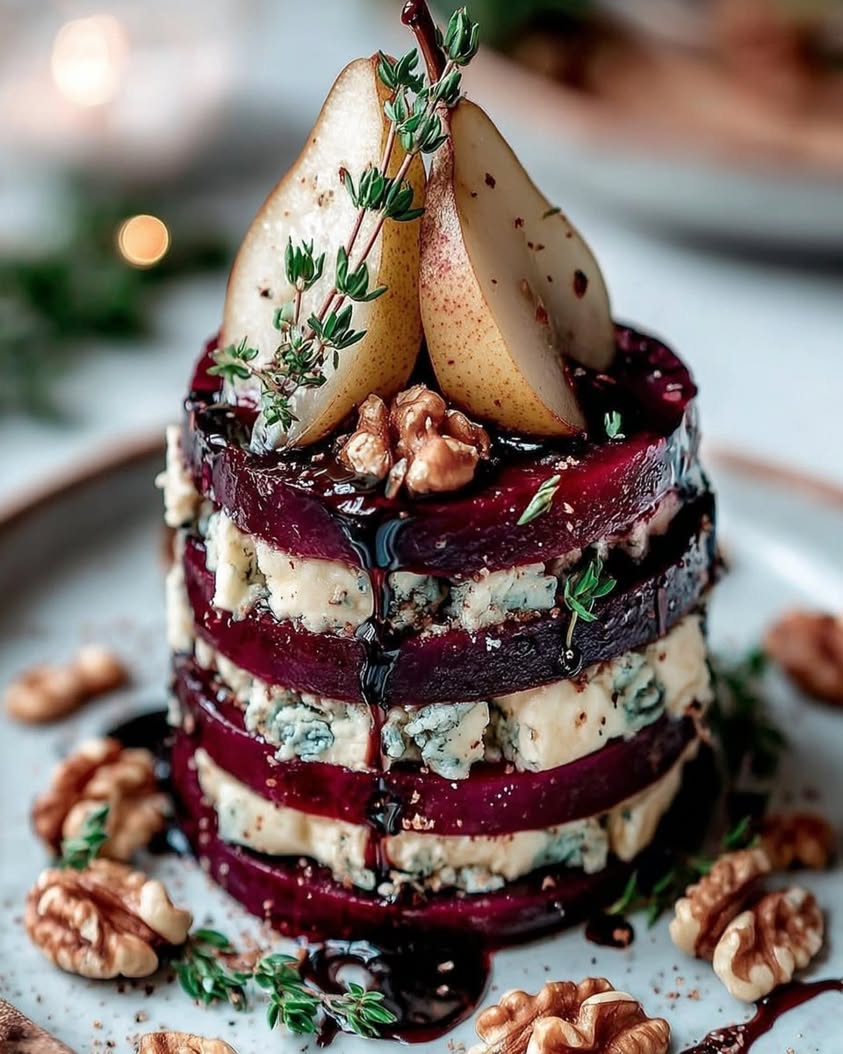
Roasted Beet Blue Cheese Towers with Pear & Balsamic Glaze: An Elegant Appetizer
You are about to discover a show-stopping appetizer that perfectly balances earthy sweetness with tangy, creamy indulgence. These roasted beet blue cheese towers with pear and balsamic glaze are not just visually stunning; they are a symphony of flavors and textures that will impress your guests. With layers of tender, sweet roasted beets, crisp pear slices, and a rich, crumbly blue cheese, each bite delivers a delightful contrast. The final drizzle of a sweet and tangy balsamic glaze ties everything together, creating a sophisticated dish that is surprisingly easy to assemble.
The beauty of this roasted beet blue cheese towers with pear and balsamic glaze recipe lies in its simplicity and elegance. It requires minimal cooking effort, primarily roasting the beets, while the assembly is quick and straightforward. This makes it a perfect choice for a dinner party starter, a festive holiday appetizer, or even a unique salad topping. The vibrant colors of the deep red beets, the pale green pear, and the white and blue cheese create a magnificent presentation on any platter.
Preparing these towers is a wonderful way to showcase seasonal produce. The natural sweetness of the beets and pears is enhanced by roasting, which also concentrates their flavors. When paired with the sharp, salty punch of blue cheese, you achieve a culinary harmony. The balsamic glaze not only adds a beautiful glossy finish but also provides a necessary acidic component that cuts through the richness of the cheese. This roasted beet blue cheese towers with pear and balsamic glaze dish is a true celebration of simple, high-quality ingredients coming together in perfect balance.
This recipe for roasted beet blue cheese towers with pear and balsamic glaze will yield 12 individual towers, which are perfect for serving as an appetizer. The prep time is about 25 minutes to peel and slice the beets and pears, while the cooking time is 45 minutes for roasting the beets to tender perfection. Therefore, the total time from start to finish is approximately 70 minutes, with a significant portion of that being hands-off roasting time.
Quick Recipe Highlights
- Flavor Profile: You will experience a delightful blend of sweet, earthy roasted beets and crisp pears, contrasted by the sharp, tangy, and creamy blue cheese. The balsamic glaze adds a sweet and sour depth that harmonizes the entire dish.
- Texture: The star of this recipe is the textural contrast. The beets become incredibly tender and melt-in-your-mouth, the pears offer a fresh, juicy crunch, and the blue cheese provides a creamy, crumbly element. This combination creates a satisfying eating experience.
- Aroma: The aroma is predominantly sweet and earthy from the roasting beets, with a subtle tanginess from the cheese. The balsamic glaze reduces to a rich, sweet, and pungent scent that fills the kitchen as it simmers.
- Visual Appeal: This dish is a feast for the eyes. The deep ruby red of the beets, the pale green of the pear, the stark white and blue veins of the cheese, and the dark, glossy balsamic glaze create a stunning color palette. The stacked tower presentation adds height and elegance.
- Skill Level Needed: This recipe is perfect for beginner cooks. The techniques are straightforward, involving roasting and assembly. The key is in the precise slicing of ingredients to ensure stable towers. A sharp knife and a little patience are all you need.
- Special Equipment: You will need a sharp chef’s knife, a baking sheet, parchment paper, a small saucepan for the glaze, and a paring knife for peeling. No specialized kitchen gadgets are required.
Recipe Overview
- Difficulty Level: This recipe is rated as easy. The simple steps involve roasting whole beets, slicing them, and layering them with other ingredients. There are no complex techniques like tempering or advanced knife work, making it accessible for any home cook to successfully prepare roasted beet blue cheese towers with pear and balsamic glaze.
- Category: This dish fits perfectly as an elegant appetizer for a dinner party, a stunning first course, or a festive finger food for holiday gatherings. You could also serve it as a unique side salad component or a light lunch option when served on a bed of arugula.
- Cuisine: While not tied to a single tradition, this recipe draws inspiration from modern American and European cuisine. The combination of fruit, cheese, and balsamic vinegar is a classic pairing found in Italian and French cooking, while the tower presentation is a contemporary American style.
- Cost: The cost is moderate. Beets are inexpensive, especially in season. Pears and blue cheese can vary in price depending on the variety, but you can find good quality options at most grocery stores. The balsamic vinegar is the most expensive ingredient if you use a high-quality aged variety, but a standard balsamic reduction is very affordable.
- Season: This dish is best made in the fall and winter when both beets and pears are in peak season. Their flavors are sweetest and most robust during this time. However, you can make it year-round using imported ingredients.
- Occasion: It is ideal for special occasions like Thanksgiving, Christmas, New Year’s Eve, or a romantic dinner at home. It also makes a sophisticated contribution to a potluck or a bridal shower. The visual impact is perfect for impressing guests.
Why You’ll Love This Recipe
First and foremost, you will love the incredible taste and texture of these roasted beet blue cheese towers with pear and balsamic glaze. Every single bite offers a complex interplay of flavors, from the earthy sweetness of the beet to the sharp, creamy tang of the cheese. The fresh, crisp pear provides a rejuvenating crunch that cuts through the richness. Finally, the balsamic glaze brings everything together with its perfect sweet and sour note, making each mouthful a balanced and memorable experience. This is not just a flavor; it is an exploration of complementary tastes.
Secondly, the convenience of this recipe is a major win for any busy home cook. The majority of the cooking time is hands-off, as the beets roast undisturbed in the oven. This frees you up to prepare other parts of your meal or simply relax. Furthermore, the assembly is incredibly fast and simple. You can easily prepare the components in advance and then stack the towers just before serving. This makes it an ideal stress-free appetizer for entertaining, allowing you to enjoy your own party rather than being stuck in the kitchen.
Moreover, this recipe offers fantastic nutritional advantages. Beets are a powerhouse of nutrients, packed with fiber, folate, potassium, and antioxidants that support heart health and reduce inflammation. Pears are also an excellent source of fiber and vitamin C. While blue cheese is rich, it also provides calcium and protein in a flavorful way. Even the balsamic glaze contributes antioxidants. Consequently, this is a dish that tastes indulgent while actually providing significant health benefits, making it a smart choice for a satisfying appetizer.
Beyond its taste and health benefits, this dish has immense social and entertaining value. Presenting these individual towers on a platter creates a stunning focal point for any gathering. Your guests will be impressed by the elegant presentation and the sophisticated flavor combination. It serves as a wonderful conversation starter. Furthermore, the portability of these towers makes them perfect for passing around at cocktail parties. They are elegant enough for a formal dinner yet approachable for a casual get-together.
Finally, this recipe is highly cost-effective and uses accessible ingredients. Beets and pears are some of the most affordable produce items at the grocery store, especially when in season. You do not need expensive or exotic ingredients to create a dish that looks and tastes like it came from a high-end restaurant. A good-quality block of blue cheese can be found for a reasonable price, and a standard balsamic vinegar reduction is simple to make at home. Therefore, you can achieve a gourmet result without breaking the bank.
Historical Background and Cultural Significance
The combination of beets, blue cheese, and pears has a long and storied history, particularly within European culinary traditions. Beets have been cultivated for thousands of years, originally grown for their leaves in ancient times, with the root becoming popular later. Pears, too, have ancient origins in Asia and Europe. Blue cheese, with its distinct veining, has been produced for centuries in caves and cellars across Europe, notably in France, Italy, and England. The pairing of sweet fruit with salty, pungent cheese is a classic technique that balances opposing flavor profiles.
This specific combination of ingredients holds cultural importance in modern gastronomy as a symbol of refined, seasonal cooking. The use of a balsamic reduction, a staple of Italian Modena, adds a layer of historical depth. The tower or stack presentation, while a contemporary technique, reflects a move in modern cuisine towards architectural plating. It emphasizes height and visual structure, transforming simple components into a work of art. Therefore, this dish represents a bridge between traditional European flavor pairings and modern American culinary presentation.
The evolution of this specific recipe can be traced through the rise of seasonal and farm-to-table dining in the United States. As chefs began to highlight the natural sweetness of root vegetables and the versatility of fruits in savory dishes, the beet and goat cheese salad became a staple in the 1990s. However, the substitution of pears for other fruits and the use of blue cheese for a bolder flavor were natural progressions. The addition of a balsamic glaze and the tower presentation elevated the concept into a more refined appetizer.
Regionally, this dish has many variations. In the American South, you might find it served with a pecan crumble and a sorghum glaze. In the Pacific Northwest, local blue cheeses like Rogue River Blue and fresh Anjou pears are often featured. In parts of Europe, the dish might be served with a walnut oil vinaigrette instead of a balsamic glaze, or with the addition of candied walnuts. Each variation highlights a local ingredient, but the core principle of balancing sweet, earthy, salty, and tangy remains universal. This adaptability has made it a beloved dish across many regions.
Ingredient Deep Dive
Beets are the foundation of this dish, and their cultural significance dates back to ancient Mesopotamia and the Mediterranean. Originally used for their medicinal properties, the root became a staple food in Roman times. Nutritionally, beets are rich in betalains, which are powerful antioxidants that give them their vibrant red color. They are also a fantastic source of folate, manganese, and dietary fiber. When selecting beets for your roasted beet blue cheese towers with pear and balsamic glaze, you should look for firm, smooth bulbs with fresh, green leaves attached, if possible. Avoid any beets that are soft or shriveled. For storage, keep them in a plastic bag in the refrigerator for up to two weeks, and always cut off the greens before storing to prevent them from drawing moisture from the root. If you need a substitution, you can use golden beets for a milder, sweeter flavor and a beautiful yellow color, or even candy cane beets for visual variety.
Blue cheese is the crucial salty, tangy component that provides the creamy texture. Its history is steeped in tradition, most famously the Roquefort cheese from France, which was aged in the natural caves of Combalou. The blue veins are created by adding cultures of Penicillium roqueforti and piercing the cheese to allow oxygen to foster the mold growth. Nutritionally, blue cheese is high in calcium and protein, and it also contains beneficial probiotics. For this recipe, select a cheese that is creamy but not overly soft, with visible blue veining. Gorgonzola is a classic choice for its milder, creamier texture, while Stilton offers a sharper, more crumbly consistency. Roquefort is very pungent and salty. You should store blue cheese tightly wrapped in paper and then plastic wrap in the cheese drawer of your refrigerator. For a dairy-free adaptation, you can use a high-quality vegan blue cheese alternative, though the flavor profile will differ.
Pears provide the essential fresh, crisp element in these towers. Pears have been cultivated in China for over 3,000 years and were highly valued by ancient Romans and Greeks. They are an excellent source of vitamin C, vitamin K, and dietary fiber, particularly pectin. When choosing pears for your roasted beet blue cheese towers with pear and balsamic glaze, you want them to be ripe but still firm enough to hold their shape when sliced. A slight give near the stem indicates ripeness. Varieties like Bosc, Anjou, or Bartlett work wonderfully. Bosc pears are especially good because they retain their shape during assembly. You should store pears at room temperature to ripen, then refrigerate them to slow down the process. If you lack pears, crisp apples like Honeycrisp or Fuji are excellent substitutes, offering a similar sweet crunch.
Balsamic vinegar is the final key player, transformed into a reduced glaze. True balsamic vinegar, or Aceto Balsamico Tradizionale, originates from Modena and Reggio Emilia in Italy, where it is aged for years in wooden barrels. This process creates a complex, sweet, and syrupy vinegar. For a glaze, you can use a good quality but less expensive aged balsamic vinegar or a standard commercial balsamic vinegar. To make the glaze, you simply simmer the vinegar until it thickens and reduces by about half. This process concentrates its sweetness and creates a glossy texture. Store your homemade balsamic glaze in an airtight jar in the refrigerator for up to a month. If you do not have balsamic vinegar, you can make a quick glaze using pomegranate molasses or a combination of red wine vinegar and honey.
Common Mistakes to Avoid
- Not roasting the beets until they are fully tender is a common error. Under-cooked beets will be hard and have a dense, chalky texture, ruining the delicate bite of your tower. They should be easily pierced with a fork with no resistance.
- Slicing the beets and pears unevenly will make your towers unstable. If the slices vary in thickness, the tower might lean or topple over. Use a sharp knife and aim for uniform, 1/4-inch thick slices.
- Using overly ripe or mushy pears is a frequent mistake. The pears should be firm enough to hold their shape when cut into rounds. Overly ripe pears will break apart and make a mess instead of providing a crisp layer.
- Forgetting to pat the roasted beet slices dry is a crucial oversight. Beets release moisture as they cool, and this excess liquid will make the towers slippery and soggy. Always dry them with a paper towel before assembly.
- Adding the balsamic glaze too early can cause the towers to become soggy and the glaze to run off the plates. Always add the glaze immediately before serving to maintain the crisp textures of the pear and the integrity of the tower.
- Using too much blue cheese can overwhelm the other delicate flavors. The cheese is meant to be a supporting player, not the main star. A small crumble in each layer provides ample flavor without dominating the palate.
- Skipping the step of letting the roasted beets cool completely is a common error. Hot beets will not only be difficult to handle but will also cause the pear and cheese to wilt and become warm. Patience is essential for a successful tower.
- Not seasoning the layers appropriately. A simple pinch of flaky sea salt and a crack of black pepper between the layers enhances all the flavors. Without this, the dish can taste flat and one-dimensional.
Essential Techniques
Roasting beets to perfection is the most critical technique for this dish. The goal is to concentrate their natural sugars and achieve a tender, almost jammy texture without them becoming mushy. To master this, you should wash the beets, trim the tops and tails, and wrap them individually in aluminum foil. Roast them in a preheated oven at 400°F (200°C) for about 45 to 60 minutes. The foil creates a steam environment that cooks them evenly. You will know they are ready when a knife slides through the center with ease. Once roasted, allow them to cool just enough to handle, then rub off the skins with a paper towel. This method prevents the loss of flavor and color that can happen if you peel them before roasting. A common pitfall is to roast them at too high a temperature, which can cause them to become tough and wrinkled.
Creating a stable tower structure is another essential skill for this recipe. The key is precision and layering. Start by placing the widest, most stable beet slice on the bottom. Then, add a small dollop of crumbled or sliced blue cheese, followed by a thin pear slice. And then, repeat the layers, tapering the size of the slices as you go up to create a cone-like shape. This is important for stability. Use a small offset spatula or your fingers to gently press down each layer to ensure they are secure and level. A common pitfall is piling ingredients too high without ensuring each layer is centered. If the tower starts to wobble, you can insert a short cocktail pick through the center to hold it all together, removing it before serving if you prefer.
Reducing balsamic vinegar into a glaze is a simple yet transformative technique. The process is straightforward but requires attention. Pour one cup of balsamic vinegar into a small, heavy-bottomed saucepan. Bring it to a gentle simmer over medium-low heat. Do not let it boil aggressively, as this can burn the sugar. You will need to stir it occasionally to prevent it from sticking or scorching. The vinegar will reduce in volume and become syrupy. You can test the consistency by dipping a spoon; the glaze should coat the back of the spoon. It will continue to thicken as it cools. A visual cue for success is when the bubbles on the surface become smaller and more dense. If you accidentally reduce it too much and it becomes hard, you can whisk in a tablespoon of warm water to loosen it slightly.
Pro Tips for Perfect Roasted Beet Blue Cheese Towers with Pear and Balsamic Glaze
For the most stable towers, use a mandoline slicer to get perfectly uniform slices of your beets and pears. This will not only look professional but ensure each layer is a consistent height, making the tower easier to stack. If you do not have a mandoline, a very sharp chef’s knife is essential for achieving thin, even slices.
Always choose a blue cheese that is creamy but not overly soft. A good Gorgonzola dolce is perfect as it is spreadable yet holds its shape. If you use a crumbly blue cheese like Stilton, press the crumbles gently together to form a cohesive layer before placing it on top of the beet slice. This prevents the cheese from falling apart.
To prevent your pears from browning after they are sliced, you can dip the rounds in a solution of water and lemon juice. This is an optional step, but it keeps them looking vibrant for longer, especially if you are prepping the components in advance. Pat them dry before assembly to avoid excess moisture.
When you are ready to serve, let your balsamic glaze come to room temperature if you have stored it in the refrigerator. A cold glaze will be too thick to drizzle beautifully. You can also thin it slightly with a drop of warm water if it has become too viscous.
Consider adding a small fresh herb leaf, such as a tiny basil leaf or a sprig of micro greens, on top of each tower just before serving. This adds a fresh, peppery note and a beautiful pop of green color that contrasts wonderfully with the dark red and white of the other ingredients.
For the best flavor, allow your blue cheese to come to room temperature for about 20 minutes before assembling the towers. This will bring out its full creamy texture and pungent aroma, allowing the true character of the cheese to shine through in every bite.
Warm your serving plate slightly before placing the assembled towers on it. This will help the final dish stay at a pleasant room temperature for a longer period of time. Be careful not to overheat it, as you do not want to melt the cheese or wilt the pears.
Do not be afraid to use different colored beets to create a more striking visual. A combination of standard red beets, golden beets, and candy cane beets will give your towers a beautiful, multi-colored appearance that is sure to impress your guests and make the dish even more memorable.
Variations and Adaptations
Regionally, this dish can be adapted to highlight local products. In the American Southwest, you could replace the balsamic glaze with a spicy honey chipotle glaze for a smoky kick. In the Midwest, you might substitute the blue cheese with a rich, buttery Wisconsin brick cheese or a creamy, mild feta. In coastal regions, a sprinkle of flaked sea salt and a squeeze of fresh lemon juice could replace the balsamic glaze for a brighter, cleaner flavor profile that complements seafood-focused meals.
Seasonal adaptations allow you to enjoy this recipe year-round with peak produce. In the late summer, you could replace the pears with fresh, sweet figs or thinly sliced peaches, which pair beautifully with blue cheese. During the autumn, roasting apples instead of pears provides a similar crisp texture but with a tarter, more distinct apple flavor. In the winter, a thin slice of roasted butternut squash could be substituted for one of the beet layers for added warmth and sweetness.
For dietary modifications, this recipe is naturally gluten-free. To make it dairy-free, you can substitute the blue cheese with a high-quality, plant-based blue cheese alternative made from cashews or coconut oil. While the flavor will be different, many vegan versions offer a similar tangy and creamy texture. For a vegan version, also ensure that your balsamic glaze is made with 100% balsamic vinegar, as some commercial varieties contain honey.
For flavor variations, consider adding a layer of caramelized onions or a thin spread of fig jam between the beets and the cheese. This will introduce a new dimension of sweetness and depth. A sprinkle of toasted, chopped pecans or walnuts on top of each tower before adding the glaze provides a welcome crunch and nutty flavor. You could also infuse your balsamic glaze with a sprig of fresh rosemary or a pinch of black pepper during the reduction process.
For texture modifications, you can roast the beets entirely tender, or leave them slightly al dente for a firmer bite. The pears can be sliced into very thin rounds for a more delicate structure, or thicker slices for a bolder pear flavor. The blue cheese can be smoothly whipped with a little cream cheese to create a cheese mousse for a completely different, spreadable texture inside the tower.
For presentation alternatives, instead of stacking towers on a plate, you can spread a bed of arugula or mixed greens on a large platter and arrange the towers on top individually. Alternatively, you can serve the components deconstructed on a platter, allowing guests to assemble their own small stacks. This is a wonderful interactive element for a cocktail party. You could also cut the finished towers in half horizontally and serve them as a cross-section, revealing the beautiful layers inside.
Serving and Presentation Guide
Plating these towers is an art that transforms simple ingredients into a masterpiece. To create a stunning presentation, place a single tower in the center of a small, appetizer-sized plate. Use a squeeze bottle or a small spoon to drizzle the balsamic glaze in an artistic swoosh or circle around the tower. Additionally, you can dot the plate with small pools of the glaze and drag a knife through them to create a pattern. The goal is to create a clean, modern look.
For garnishing ideas, a few delicate leaves of micro greens or a single fresh herb like a basil leaf, a sprig of thyme, or a piece of mint placed on top of the tower adds contrast and freshness. A light sprinkle of flaky sea salt, such as Maldon, right before serving will enhance all the flavors. You can also scatter a few toasted, chopped nuts, such as pecans or walnuts, around the plate for added texture and visual interest.
Traditional accompaniments for this dish include a simple side of mixed greens dressed with a light vinaigrette. The bitterness of arugula or the peppery taste of watercress is a classic pairing that complements the sweetness of the beets and the richness of the cheese. Fresh, crusty bread or a baguette is another common side, useful for sopping up any extra balsamic glaze on the plate.
Modern serving suggestions include serving this as a light lunch or a main course salad component by placing the tower on a large bed of arugula, spinach, or mixed greens. You could also serve it as a side dish to a heavy winter meal, like a pot roast or a roasted chicken, where the bright, tangy flavors cut through the richness of the main protein. For a cocktail party, make smaller, bite-sized towers using a single layer of each component.
Temperature considerations are critical. The roasted beet blue cheese towers with pear and balsamic glaze should be served at room temperature or slightly chilled. The beets can be warm, but the pears and cheese should be cool. Assemble the towers just before serving to ensure the pears remain crisp and the balsamic glaze does not become runny. If you have prepared the components in advance, bring them to room temperature before assembly.
For portion control, a single 1.5 to 2-inch tall tower is a perfect appetizer portion. If serving as a first course, you can make the towers slightly larger, using three or four layers of each component. For a cocktail party, one tower per person is standard, but you might want to make one or two extra for hungry guests. Because they are not too heavy, you can serve two towers as a generous starter portion.
Wine and Beverage Pairing
Wine pairing for this dish is a wonderful way to elevate the dining experience. The sweetness of the beets and pears, combined with the tangy blue cheese, calls for a wine that can match its intensity. A classic pairing is a late-harvest Riesling or a Gewürztraminer. Their residual sweetness perfectly balances the saltiness of the blue cheese, while their acidity cuts through the richness. Another excellent choice is a Sauternes or a late-harvest Chenin Blanc, which offer notes of honey and stone fruit that complement the balsamic glaze beautifully.
For a non-alcoholic alternative, a sparkling apple cider or a non-alcoholic sparkling wine is a fantastic choice. The bubbles cleanse your palate and the fruitiness echoes the pear in the dish. A high-quality, unsweetened pomegranate juice also makes a wonderfully complex pairing, as its tartness and depth mimic the balsamic glaze. For a coffee pairing, a rich, dark roast with notes of chocolate and a low acidity will provide a bold contrast to the dish without overwhelming its delicate flavors.
If you prefer a red wine, a lighter, fruit-forward option is best. A Pinot Noir from California or Oregon, with its bright cherry and strawberry notes, will not overpower the dish. Its soft tannins and good acidity make it a flexible partner. Alternatively, a Beaujolais cru, like a Fleurie or Morgon, offers bright fruit flavors and a lightness that complements the dish’s fresh components. Avoid heavy, tannic red wines like Cabernet Sauvignon, as they will clash with the cheese and beets.
When serving these beverages, temperature is key. White wines and sparkling options should be served well-chilled, between 45 and 50 degrees Fahrenheit. The red wine should be served slightly cool, around 60 degrees Fahrenheit, to keep its fruit forward. For non-alcoholic options, chilled apple cider is perfect. Serve these in elegant stemware that complements the visual appeal of the tower itself, creating a cohesive and sophisticated presentation.
Storage and Shelf Life
Proper storage of leftovers is essential to maintain the quality of your roasted beet blue cheese towers with pear and balsamic glaze. However, these towers are best enjoyed immediately after assembly. If you have leftover components, they can be stored separately. The roasted beets can be stored in an airtight container in the refrigerator for up to 5 days. The pear slices, if not used, should be stored in a container with a tight-fitting lid, and you can sprinkle them with lemon juice to prevent browning.
For temperature requirements, all components should be kept refrigerated at 40 degrees Fahrenheit or below. The blue cheese should be wrapped in its original paper or in parchment paper, then placed inside a zip-top bag to maintain its moisture without becoming slimy. The balsamic glaze can be stored in a sealed jar in the refrigerator for up to a month. If it thickens too much when cold, you can let it sit at room temperature for a few minutes or warm it slightly in the microwave.
Container recommendations are important to avoid flavor transfer. Beets have a strong flavor and can stain plastic containers. Therefore, it is best to store them in glass or ceramic containers. The blue cheese can impart a strong aroma to other foods, so it should be stored in its own container or well-sealed bag. The balsamic glaze is best kept in a small, airtight glass jar to prevent it from absorbing any other refrigerator odors.
Signs of spoilage include any mold on the roasted beets beyond a small white spot, which can be cut away. However, if the beets become slimy or have an off, sour smell, they should be discarded. The blue cheese will naturally have its own mold, but if it develops an ammonia-like smell or becomes overly slimy, it is past its prime. The pears will become mushy and brown if stored for too long, and their texture will be compromised. The balsamic glaze is very stable but should be discarded if you see any signs of mold or a change in its smell.
Reheating instructions are not typically required, as the towers are served cold or at room temperature. If you wish to use leftover roasted beets in another preparation, you can reheat them in a pan with a little butter or olive oil. The pear slices and blue cheese should not be reheated. If you are serving the dish later, it is best to assemble the towers fresh rather than trying to store them assembled.
Freezing guidelines are not recommended for this dish. The texture of the pears and blue cheese will be compromised by freezing and thawing. The roasted beets can be frozen for up to 3 months in an airtight container, but their texture will become softer upon thawing, which is fine for a puree or soup but not ideal for this tower presentation. The balsamic glaze freezes well in a sealed container.
Make Ahead Strategies
This recipe is perfect for entertaining because you can prepare almost all the components in advance. The roasted beets can be cooked, peeled, and sliced up to three days ahead of time. This allows you to completely remove the most time-consuming step from your party day. The balsamic glaze can also be made a week in advance and stored in the refrigerator. This leaves you with just the simple task of slicing the pear and assembling the towers on the day of your event. This prep-heavy timeline is the key to stress-free hosting.
Storage between steps is critical for maintaining freshness. Store the sliced, roasted beets in an airtight container in the refrigerator. Place a sheet of parchment paper between the layers to prevent them from sticking together. The balsamic glaze should be covered and kept in the fridge. The blue cheese should be kept in its original packaging or re-wrapped in cheese paper. Keep the whole pears, unsliced, in the refrigerator until you are ready to assemble the towers. This preserves the freshness of every component.
Assessing quality impact is important when making this dish ahead. The roasted beets will actually deepen in flavor after a day or two in the fridge, which is beneficial. The balsamic glaze remains stable and delicious for weeks. The blue cheese can be sliced or crumbled in advance, but it will oxidize slightly, so it is best to do this on the day of assembly. The texture of the pears is the most sensitive to time; they must be sliced just before you assemble the towers to ensure they are crisp and do not brown.
For assembly tips, you should retrieve all your components from the refrigerator about 20 minutes before assembly to bring them to room temperature. This makes the blue cheese creamier and easier to work with, and the beets will be less firm. Arrange your sliced beets, pear rounds, and cheese on a cutting board so you can work quickly and efficiently. Assemble the towers directly on your serving platter to avoid having to move them.
Reheating guidelines are unnecessary for the assembled towers. The goal is to serve them cool or at room temperature. You do not want to reheat any part of the assembled tower, as it will melt the cheese and soften the pear. If you want to slightly warm the beets, you can do so in a low oven before you start assembly, but this is an optional step that changes the final temperature of the dish.
For fresh element additions, you can not add any fresh elements ahead of time. The pear and any herb garnishes must be added at the very end. This is what will make your dish taste vibrant and fresh despite the components being prepped. A light squeeze of fresh lemon juice on the pears can also help prevent browning just before assembly.
Scaling Instructions
Halving the recipe is very straightforward for this dish. To produce 6 towers instead of 12, use 2-3 medium-sized beets, 1 large ripe pear, and about 4 ounces of blue cheese. The timing for roasting the beets will remain the same, as you can roast fewer beets on the same baking sheet. All other steps scale down proportionally. The amount of balsamic vinegar for the glaze should be reduced to 1/2 cup. The cooking time for the Print
Roasted Beet Blue Cheese Towers with Pear & Balsamic Glaze
- Total Time: 60 minutes
- Yield: 4
Description
A stunning vegetarian appetizer featuring layers of roasted beets, tangy blue cheese, and sweet pear, drizzled with balsamic glaze.
Ingredients
- 4 medium red beets, scrubbed
- 2 ripe pears, thinly sliced
- 4 ounces blue cheese, crumbled
- 1/4 cup balsamic vinegar
- 2 tablespoons honey
- 1 tablespoon olive oil
- Salt and black pepper to taste
- Micro greens or arugula for garnish
Instructions
- Preheat oven to 400°F (200°C). Wrap each beet in foil and roast for 45-60 minutes until tender. Let cool, then peel and slice into 1/4-inch rounds.
- While beets roast, make the glaze: In a small saucepan, combine balsamic vinegar and honey. Simmer over medium-low heat for 8-10 minutes until thickened and syrupy. Set aside.
- To assemble towers: On a serving plate, layer a beet slice, top with a pear slice, and sprinkle with blue cheese. Repeat layers until desired height, ending with cheese.
- Drizzle the towers with balsamic glaze and olive oil. Season with salt and pepper. Garnish with micro greens and serve immediately.
Notes
You can customize the seasonings to taste. For a milder flavor, use goat cheese instead of blue cheese.
- Prep Time: 15 minutes
- Cook Time: 45 minutes
- Method: Appetizer
- Cuisine: American