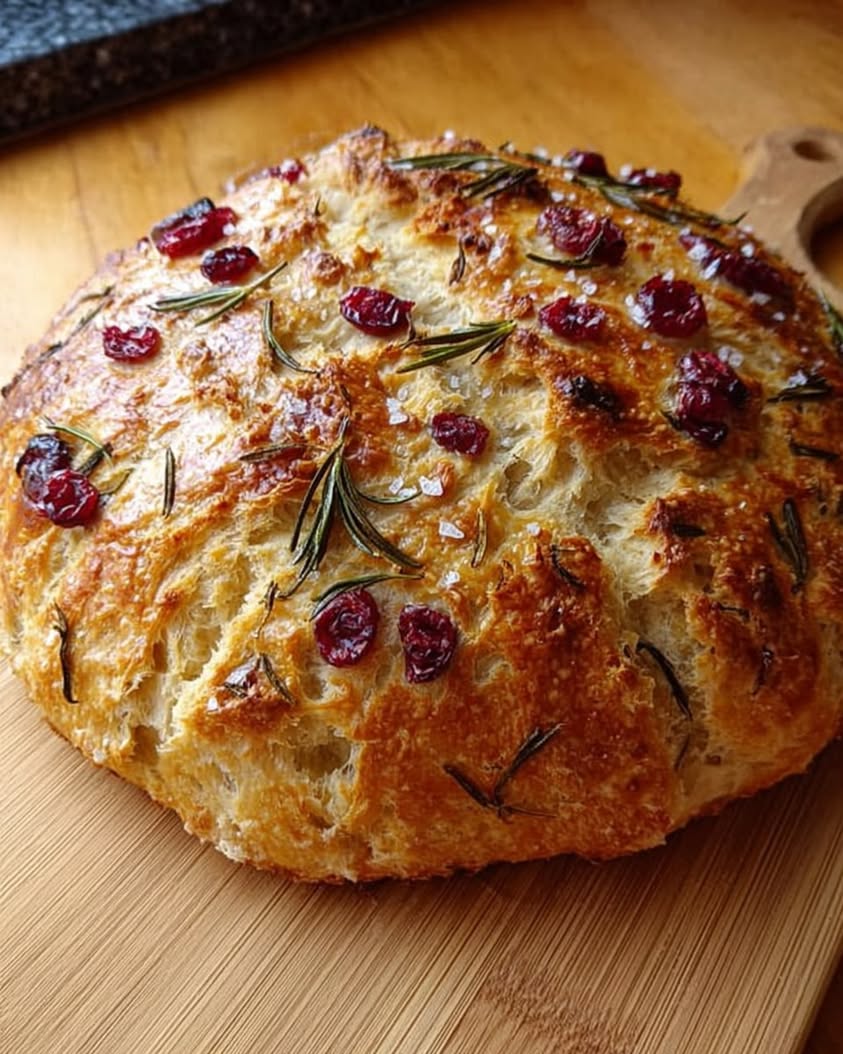
No-Knead Rosemary Cranberry Bread with Olive Oil and Sea Salt: The Effortless Artisan Loaf
Imagine pulling a golden, crackling loaf of bread from your oven, its crust dusted with flaky sea salt and its interior studded with jewel-like cranberries. This No-Knead Rosemary Cranberry Bread with Olive Oil and Sea Salt delivers that exact experience with minimal effort. Furthermore, it transforms your kitchen into a bakery filled with the warm, comforting aromas of fresh herbs and toasted grain. This recipe proves that incredible, artisan-quality bread is not just for professionals.
Consequently, this loaf is a perfect harmony of savory and sweet, rustic and refined. The earthy, piney fragrance of fresh rosemary beautifully balances the tart pop of dried cranberries. Meanwhile, a generous glug of quality olive oil ensures a tender, moist crumb with a subtle fruitiness. Finally, a sprinkle of coarse sea salt on top creates delightful bursts of flavor and a wonderfully crisp, shattering crust. This No-Knead Rosemary Cranberry Bread with Olive Oil and Sea Salt is a true celebration of simple, high-quality ingredients.
Ultimately, this method is revolutionary for home bakers. The long, slow fermentation does all the work for you, developing complex flavor and an open, airy texture without any kneading. Therefore, you can mix the dough in five minutes one evening and wake up to bread ready for the oven. This process is not just easy; it is also deeply rewarding, connecting you to the timeless tradition of bread-making.
Quick Recipe Highlights
- Flavor Profile: This bread masterfully combines savory, herbal notes from fresh rosemary with the bright, tangy sweetness of dried cranberries. The rich, peppery undertone from extra virgin olive oil and the finishing crunch of sea salt create a perfectly balanced bite in every slice.
- Texture: Expect a crisp, blistered crust that gives way to a soft, chewy, and remarkably open crumb. The cranberries add juicy pockets of texture, while the slow fermentation creates those desirable irregular holes characteristic of great artisan bread.
- Aroma: As it bakes, your kitchen will fill with the warm, woody scent of rosemary melding with the sweet, toasty fragrance of baking bread. The olive oil contributes a subtle grassy note, creating an incredibly inviting olfactory experience.
- Visual Appeal: The loaf boasts a rustic, flour-dusted exterior with a deep golden-brown crust, dramatic cracks, and sparkling flakes of salt. Inside, the contrast of the deep red cranberries against the pale yellow crumb is stunningly beautiful.
- Skill Level Needed: This recipe is designed for absolute beginners. There is no kneading, no complicated shaping, and no special equipment required beyond a mixing bowl and a Dutch oven. Patience is the only true skill needed.
- Special Equipment: A heavy, lidded Dutch oven is the key tool, as it creates the perfect steamy environment for a professional-style crust. Otherwise, you only need a large bowl, a wooden spoon, and parchment paper for easy handling.
Recipe Overview
- Difficulty Level: We rate this recipe as “Easy” because it eliminates the most intimidating steps of traditional bread baking. There is no kneading, no precise windowpane tests, and no fussy temperature control. The hands-on time is under 15 minutes; the rest is passive fermentation. Even a first-time baker can achieve spectacular results.
- Category: This loaf falls squarely into the category of Artisan Yeast Breads. It is also a fantastic Holiday or Celebration Bread due to its festive ingredients. Moreover, it serves as a wonderful Breakfast or Brunch item, a perfect side for Soups and Salads, and an impressive addition to any Charcuterie or Cheese Board.
- Cuisine: This bread draws inspiration from Mediterranean and Italian culinary traditions, celebrated for their use of olive oil, rosemary, and simple, high-quality grains. The no-knead technique itself has roots in European peasant baking, making it a rustic, globally-inspired staple.
- Cost: Making this No-Knead Rosemary Cranberry Bread with Olive Oil and Sea Salt is incredibly cost-effective. A single loaf costs a fraction of what you would pay at a specialty bakery. Basic pantry staples like flour, yeast, and salt form the foundation, while the rosemary, cranberries, and good olive oil are affordable splurges that deliver immense flavor.
- Season: While delightful year-round, this bread truly shines in the fall and winter months. The rosemary and cranberries evoke cozy, holiday feelings. It is the perfect companion to hearty stews and holiday meals. Conversely, it also makes a lovely spring or summer bread when served with fresh cheeses and seasonal fruits.
- Occasion: This versatile loaf is ideal for holiday dinners, festive brunches, or as a thoughtful homemade gift. It elevates a simple weeknight soup into a special meal and is always the star of a casual gathering. Basically, any occasion is improved by the presence of warm, freshly baked bread.
Why You’ll Love This Recipe
First and foremost, the taste and texture of this No-Knead Rosemary Cranberry Bread with Olive Oil and Sea Salt are utterly irresistible. Each slice offers a symphony of contrasts: the crisp, salty crust against the soft, yielding interior, the savory herb against the tart fruit. The long fermentation develops a subtle tanginess that makes this bread deeply flavorful and complex, rivaling any bakery loaf. You will find it impossible to stop at just one piece, especially when it is still warm from the oven.
Furthermore, the convenience factor is a major win. This recipe fits seamlessly into a busy schedule. You simply mix the dough before bed, let it work its magic overnight, and bake it the next day. There is no need to plan your day around rising times or complicated steps. This hands-off approach demystifies bread baking, making it an accessible and stress-free kitchen project for anyone, regardless of their experience level.
From a nutritional perspective, homemade bread like this allows you to control exactly what goes into your food. You avoid the preservatives and additives common in store-bought loaves. Ingredients like olive oil provide heart-healthy fats, while whole wheat flour adds fiber. Using natural, unprocessed ingredients means you are nourishing your body with real food, which is always a benefit.
Additionally, the social and entertaining value of this bread is immense. Presenting a homemade, artisan-style loaf to guests is always impressive. It sparks conversation, creates a warm and welcoming atmosphere, and shows a level of care that store-bought items cannot match. Breaking bread together, especially bread you made yourself, fosters connection and makes any meal feel more special and intentional.
Finally, the cost-effectiveness and accessibility are undeniable. For the price of one artisan loaf from a boutique bakery, you can make several of these at home. The ingredients are easy to find at any standard grocery store. This recipe empowers you to create a luxury item in your own kitchen without a luxury budget, proving that incredible food does not have to be expensive or complicated.
Historical Background and Cultural Significance
The story of no-knead bread is a fascinating modern chapter in the ancient history of baking. While the technique feels revolutionary, it actually recalls a time before commercial yeast and electric mixers. For millennia, bread was made with wild starters and long, slow fermentations. Bakers relied on time, not muscle, to develop gluten. The specific method popularized by Jim Lahey in 2006 was a rediscovery of this principle, using a very wet dough and a long rise to create an open crumb and complex flavor without laborious kneading.
Culturally, bread is a universal symbol of sustenance, community, and sharing. The addition of rosemary and cranberries in this loaf ties it to seasonal and regional traditions. Rosemary, an herb steeped in symbolism for remembrance and fidelity, has been used in European cooking and medicine for centuries. Cranberries, native to North America, bring a touch of New World heritage. Combining these elements creates a bread that bridges culinary traditions, celebrating both Old World technique and New World ingredients.
The evolution of this specific recipe follows a natural path of home baker innovation. The basic no-knead formula became a canvas for creativity. Bakers began experimenting with add-ins like herbs, dried fruits, nuts, and cheeses. The No-Knead Rosemary Cranberry Bread with Olive Oil and Sea Salt is a perfect example of this evolution—a simple master recipe personalized with flavorful additions that tell a story. It represents how home cooking adapts and personalizes foundational techniques.
Regional variations of this concept are endless. In Provence, you might find olives and herbes de Provence. In Tuscany, sun-dried tomatoes and basil. The cranberry and rosemary combination has a particularly American holiday feel, but it can be adapted to any cuisine. This adaptability is the true beauty of the no-knead method; it provides a reliable framework that welcomes global flavors and personal touches, allowing every baker to create a loaf that reflects their own taste and heritage.
Ingredient Deep Dive
Let us start with bread flour, the backbone of this No-Knead Rosemary Cranberry Bread with Olive Oil and Sea Salt. Bread flour has a higher protein content (typically 12-14%) than all-purpose flour. This protein is crucial because it develops into gluten during the long fermentation. Gluten forms the network that traps the carbon dioxide produced by the yeast, giving the bread its structure and those beautiful, irregular holes. For best results, use unbleached bread flour. Store it in a cool, dry place, or in the freezer for long-term storage to prevent the fats in the wheat germ from going rancid.
Active dry yeast is our leavening agent. This microscopic fungus feeds on the sugars in the flour, producing gas that makes the dough rise. The long, cool fermentation in this recipe allows for incredible flavor development beyond just rise. The yeast has time to produce subtle acidic compounds, giving the bread a nuanced, slightly tangy taste reminiscent of sourdough. Always check the expiration date on your yeast. You can proof it in a little warm water with a pinch of sugar to ensure it is active, though with such a long rise, even slightly older yeast often works perfectly.
Fresh rosemary is non-negotiable for the best flavor. The volatile oils in fresh rosemary are bright, piney, and aromatic, which infuse the dough beautifully. Dried rosemary can be used in a pinch, but it will have a woodier, less vibrant taste. To prepare fresh rosemary, strip the leaves from the woody stem and chop them finely. This releases the oils. Rosemary has a long history of use, symbolizing remembrance and often found in wedding and funeral traditions, adding a layer of meaning to your baking.
Dried cranberries provide sweet-tart bursts of flavor and chewy texture. Look for unsweetened or fruit juice-sweetened varieties to avoid an overly sugary loaf. If your cranberries are very dry, plump them by soaking in warm water or orange juice for 10-15 minutes before adding to the dough, then drain well. Cranberries are native to North America and were used by Indigenous peoples for food, dye, and medicine. Their vibrant color and tangy flavor make them a festive and healthy addition, rich in antioxidants and vitamin C.
Extra virgin olive oil is a star ingredient. It enriches the dough, yielding a more tender crumb and a longer-lasting moistness. It also contributes a fruity, peppery background note that complements the rosemary and cranberries. Use the best quality you have for drizzling; its flavor will shine through. Olive oil is central to the Mediterranean diet, celebrated for its heart-healthy monounsaturated fats and anti-inflammatory properties. It binds the ingredients together in both texture and cultural spirit.
Coarse sea salt serves two critical roles. First, it regulates yeast activity and strengthens gluten in the dough. Second, when sprinkled on top before baking, it creates delightful salty bursts and enhances crust texture. The large flakes do not fully melt, providing texture and visual appeal. Sea salt is harvested through evaporation and contains trace minerals. Finishing with a flaky salt like Maldon elevates the presentation and taste dramatically, making the final product truly special.
Common Mistakes to Avoid
- Using All-Purpose Flour Instead of Bread Flour: Bread flour’s higher protein content is essential for developing enough gluten structure in this wet, no-knead dough. All-purpose flour can result in a flatter, denser loaf because the gluten network is weaker. If you must substitute, add one tablespoon of vital wheat gluten per cup of all-purpose flour to compensate.
- Not Measuring Flour Correctly: The most common baking error is scooping flour directly from the bag with the measuring cup, which packs it down. Always spoon flour lightly into your measuring cup and level it off with a knife. For absolute accuracy, use a kitchen scale. Too much flour makes a dry, dense dough that cannot rise properly.
- Using Hot Water to Mix the Dough: Yeast is a living organism. Water that is too hot (above 110°F) will kill it, preventing your dough from rising at all. Use lukewarm water, ideally between 100-110°F—it should feel warm but not hot to the touch. Conversely, cold water will simply slow the initial fermentation.
- Skimping on the Fermentation Time: The long, slow rise is the magic of this No-Knead Rosemary Cranberry Bread with Olive Oil and Sea Salt. Cutting it short means less flavor development and a less open crumb. Ensure your dough rises for the full 12-18 hours in a draft-free spot. The surface should be bubbly and the dough more than doubled in size.
- Forgetting to Preheat the Dutch Oven: The Dutch oven must be piping hot when the dough goes in. This immediate, intense heat creates “oven spring,” the final burst of rising that gives the loaf its height and crackly crust. Placing dough into a cold pot will result in a pale, gummy crust. Preheat it for a full 30 minutes.
- Using a Non-Heatproof Lid or Handle: Ensure your Dutch oven’s lid and any handles are oven-safe to the recipe’s temperature (450°F). Plastic knobs will melt. If your lid has a plastic knob, remove it and cover the pot with foil, then place the lid on top, or use an all-metal lid.
- Overhandling the Dough During Shaping: When you turn the dough out for its final shape, handle it gently. The goal is to create surface tension without deflating all the beautiful bubbles inside. Folding it over itself a few times is sufficient. Aggressive kneading or punching will degas the dough and lead to a tight crumb.
- Not Letting the Dough Rest After Shaping: The 30-minute rest after shaping, while the Dutch oven preheats, is a final proof. This allows the gluten to relax and the dough to puff up slightly again, ensuring a better final rise in the oven. Skipping this can limit oven spring.
- Neglecting to Score the Dough: A shallow slash on top with a sharp knife or razor blade is not just decorative. It controls where the bread expands in the oven. Without this “score,” the loaf can burst unpredictably through weak spots, leading to a misshapen final product.
- Opening the Oven Too Early: Resist the urge to open the oven door during the first 30 minutes of baking with the lid on. This releases the crucial steam that keeps the crust soft initially, allowing for maximum oven spring. Peeking can cause the loaf to collapse or prevent a proper rise.
Essential Techniques
Autolyse is a technique where flour and water are mixed and left to rest before adding yeast and salt. While not a formal step here, the long fermentation achieves a similar result. This rest allows the flour to fully hydrate, which jumpstarts gluten development naturally. Consequently, you get a stronger, more elastic dough with less effort. Mastering this concept means understanding that time is your most valuable tool in bread baking, not muscle.
Long, Cold Fermentation is the cornerstone of this recipe. This technique involves letting the dough rise for an extended period (12-18 hours) at room temperature. The slow yeast activity produces gases and organic acids that create incredible depth of flavor and an open, holey crumb. The key is to find a draft-free spot in your kitchen. Visual cues for success are a dough that is bubbly on top, jiggly when shaken, and has more than doubled in volume. A common pitfall is placing it in too cold or too hot an area, which disrupts the timeline.
Creating Steam in a Home Oven is achieved by using a lidded Dutch oven. The dough’s own moisture evaporates in the sealed, hot environment, creating steam. This steam keeps the crust soft and supple during the initial bake, allowing the loaf to achieve maximum oven spring (its final rise). After removing the lid, the dry heat then crisps and browns the crust perfectly. The essential technique is ensuring your Dutch oven is preheated for a full 30 minutes to be brutally hot, mimicking a professional baker’s steam-injected oven.
Gentle Shaping is critical for preserving the air bubbles. After the long rise, the dough is very loose and sticky. The technique involves using wet hands or a dough scraper to gently fold the dough over itself onto a floured surface, creating a rough ball with surface tension. The goal is not to knead but to coax it into shape. Overhandling deflates the structure. Success looks like a slightly taut, poufy dough ball that holds its shape without being tight or dense.
Pro Tips for Perfect No-Knead Rosemary Cranberry Bread with Olive Oil and Sea Salt
First, use a kitchen scale for flawless consistency. Measuring flour by weight (grams) is the single most accurate method and eliminates the guesswork of cup measurements, guaranteeing perfect dough hydration every single time you bake.
Second, consider adding a small amount of whole wheat flour. Replacing 10-20% of the bread flour with whole wheat adds a subtle nuttiness and extra nutrients without compromising the open crumb, enhancing the rustic character of the loaf.
Third, toast your rosemary lightly. Briefly warming chopped rosemary in the olive oil for just 30 seconds before adding it to the dough unlocks and intensifies its aromatic oils, distributing its flavor more evenly throughout the entire bread.
Fourth, ensure your cranberries are evenly distributed. Toss the dried cranberries in a tablespoon of the measured flour before folding them in. This light coating prevents them from sinking to the bottom of the dough during the long fermentation.
Fifth, listen to your bread. When you think the loaf is done, tap the bottom. It should sound hollow, like a drum. This auditory cue is a reliable indicator that the interior is fully baked through and not gummy.
Sixth, let it cool completely. This is the hardest but most important tip. Slicing into warm bread releases steam and makes the crumb gummy. Allowing it to cool for at least 2 hours lets the structure set, yielding the perfect chewy texture.
Seventh, experiment with different salts. While coarse sea salt is classic, trying flaky finishing salts like Maldon or smoked sea salt can add an extra dimension of flavor and a spectacular visual texture to the crust.
Eighth, track your environment. If your kitchen is very cold, the rise may take longer. If it is very warm, it may be faster. Learn to read the dough (bubbly, doubled) rather than watching the clock rigidly for the most reliable results.
Variations and Adaptations
For regional variations, imagine a Mediterranean version with kalamata olives, sun-dried tomatoes, and oregano. A French-inspired loaf could feature herbes de Provence and a touch of grated Gruyère cheese. An American fall variation might include toasted pecans and a drizzle of maple syrup in the dough. The basic no-knead framework welcomes these global flavors beautifully.
Seasonal adaptations are simple and fun. In spring, try adding lemon zest and fresh thyme. For summer, consider chopped dried apricots and lavender. Autumn is perfect for this rosemary-cranberry combo or adding toasted walnuts. Winter welcomes bold flavors like chopped figs, anise seed, or even a swirl of chestnut purée.
Dietary modifications are straightforward. For a vegan version, ensure your sugar is vegan-friendly. For a gluten-free adaptation, use a high-quality 1:1 gluten-free flour blend and add 1 teaspoon of xanthan gum to help with structure, though the crumb will be denser. There is no dairy in the base recipe, making it naturally dairy-free.
Flavor variations are endless. Swap rosemary for fresh thyme or sage. Replace cranberries with chopped dried cherries, blueberries, or raisins. Add toasted nuts like walnuts, pecans, or pistachios for crunch. For a savory twist, fold in grated sharp cheddar cheese and crispy bacon bits.
Texture modifications can be achieved by ingredient swaps. Using half bread flour and half whole wheat or rye flour creates a denser, heartier crumb. Adding seeds like sunflower, pumpkin, or flax to the dough or on top of the loaf introduces wonderful crunch and nutritional value.
Presentation alternatives include baking the dough in a preheated loaf pan for a more traditional sandwich shape. You can also divide the dough to make two smaller boules or even roll it out, spread with a filling, and shape it into a festive wreath or braid for special occasions.
Serving and Presentation Guide
For plating, place the whole, rustic loaf on a wooden cutting board or a simple ceramic platter. Use a sharp serrated bread knife for clean slices that do not compress the airy crumb. Presenting the loaf whole allows guests to admire the beautiful, crackled crust and sparkling salt before you cut into it.
Garnishing can be as simple as a fresh rosemary sprig tucked beside the loaf or a small bowl of high-quality olive oil mixed with balsamic vinegar for dipping. A dusting of flour on the board and a little pile of extra sea salt or cranberries around the base adds a professional, styled touch.
Traditional accompaniments include softened butter, preferably salted or whipped with a touch of honey. For a cheese course, pair it with a creamy brie, a sharp aged cheddar, or a tangy goat cheese. It is also perfect with olive tapenade or a rich chicken liver pâté.
Modern serving suggestions involve using thick slices for gourmet toast topped with avocado, ricotta and honey, or smoked salmon. Cube stale bread for a premium crouton in salads or a savory bread pudding. It also makes an exceptional base for crostini at parties.
Temperature considerations are key. This bread is sublime served warm, but not hot, as the flavors are more pronounced. If serving with cheese, let the cheese come to room temperature as well. For soup dipping, warm slices slightly to maximize their absorbency and comfort factor.
Portion control tips are helpful because this bread is irresistible. Pre-slicing the loaf on the board encourages people to take just a slice or two. If serving as an appetizer, consider pre-slicing it into smaller pieces for crostini to make it easier for guests to manage.
Wine and Beverage Pairing
Wine pairings should complement the savory-sweet profile. A dry rosé with its berry notes and acidity beautifully mirrors the cranberries and cuts through the richness. A medium-bodied Pinot Noir, with its red fruit and earthy undertones, is another excellent match. For white wine lovers, an oaked Chardonnay has the body to stand up to the bread, and its buttery notes pair well with the olive oil.
Non-alcoholic alternatives can be just as thoughtful. Sparkling water with a twist of orange or a splash of cranberry juice echoes the loaf’s fruitiness. A tart cherry or pomegranate spritzer also works wonderfully. For a warmer option, a lightly sweetened hibiscus tea provides a lovely tart contrast.
Coffee and tea pairings are excellent for breakfast or brunch. A medium-roast coffee with low acidity complements the bread without overpowering it. A black tea like Earl Grey, with its citrusy bergamot notes, pairs nicely with the cranberries. For an herbal option, a rosemary-infused tea would create a delightful flavor echo.
Temperature considerations for beverages depend on the meal. Serve red wine slightly below room temperature and white wines well chilled. Non-alcoholic spritzers should be icy cold. Coffee and tea, of course, should be served hot to provide a comforting contrast to the room-temperature or warm bread.
Serving suggestions include offering a choice of pairings. Place a bottle of wine, a pitcher of iced tea, and a carafe of water on the table. This allows guests to choose what they prefer and encourages them to experiment with how different sips change the taste of the No-Knead Rosemary Cranberry Bread with Olive Oil and Sea Salt.
Storage and Shelf Life
Storage methods are crucial for maintaining freshness. Once completely cool, store the bread at room temperature. Do not refrigerate it, as the cold temperature accelerates staling by recrystallizing the starch. The best method is to place the cut-side down on a cutting board and cover the exposed cut end with a clean kitchen towel. This allows the crust to stay crisp while protecting the crumb.
For longer storage, use a bread box or a paper bag, which allows the bread to breathe. Plastic bags trap moisture and quickly make the crust soft and chewy, though they can be used if you prefer a soft crust. If using plastic, ensure the bread is completely cool to prevent condensation and mold.
Container recommendations include a traditional ceramic bread box, a linen bread bag, or simply a large, clean ceramic bowl inverted over the loaf on the counter. The goal is to protect it from drying out too quickly while still allowing some air circulation to keep the crust from becoming soggy.
Signs of spoilage are typically mold, which appears as fuzzy blue, green, or white spots. If you see any mold, discard the entire loaf, as spores can penetrate throughout. Stale bread is dry and hard but still safe to eat; it can be revived or used for other purposes like breadcrumbs or croutons.
Reheating instructions are simple. To restore just-baked warmth and crispness, place a slice or the whole loaf (wrapped in foil if you want a soft crust) in a 350°F oven for 5-10 minutes. For a single slice, toasting is the fastest and most effective method, bringing back its delightful texture.
Freezing guidelines are excellent for long-term storage. Wrap the completely cooled loaf or individual slices tightly in plastic wrap, then in foil or a freezer bag. It will keep for up to 3 months. Thaw at room temperature in its wrapping to prevent condensation, then refresh in the oven as described above.
Make Ahead Strategies
The prep timeline is built into the recipe. The ultimate make-ahead strategy is to mix the dough in the evening and let it ferment overnight. You can even mix the dry ingredients (flour, salt, yeast, rosemary) in the bowl ahead of time, then simply add the water, oil, and cranberries when you are ready to start the rise.
For storage between steps, the initial long fermentation is the only “between step.” The dough can sit at room temperature for up to 18 hours. If your schedule changes, you can gently deflate the dough, cover it, and place it in the refrigerator to slow the rise for up to 24 additional hours. Let it come to room temperature for an hour before shaping and baking.
Quality impact assessment shows that the slow, cold fermentation only improves flavor. Refrigerating the shaped dough during its final 30-minute proof can be done if you need to delay baking, though it may slightly reduce oven spring. The flavor, however, will remain excellent.
Assembly tips for advance prep are minimal, as the recipe is so simple. Having your ingredients measured and your tools (bowl, spoon, Dutch oven) ready is the best preparation. You can also line your proofing bowl with parchment paper in advance, so the shaped dough is ready to be lifted directly into the hot pot.
Reheating guidelines for a fully baked, stored loaf are covered above. The key is to use the oven or toaster, not the microwave, to restore texture. The microwave will steam the bread, making it rubbery, though it can work in a pinch if you are not concerned with crust quality.
Fresh element additions after baking are not typical for this bread, as all flavors are baked in. However, you could brush the hot loaf with a little extra olive oil and sprinkle with more fresh rosemary for an intensified aroma and glossy finish right before serving.
Scaling Instructions
Halving the recipe is simple for a smaller loaf. Precisely halve all ingredients. Use a smaller (3-4 quart) Dutch oven if you have one, and reduce the baking time by 5-10 minutes. The fermentation time will remain roughly the same, as yeast activity is dependent on temperature, not volume.
Doubling or tripling the recipe is easy for feeding a crowd. Multiply all ingredients accurately. You must mix and ferment the dough in separate, large bowls—do not try to combine double the dough in one bowl, as it will not develop properly. You will need to bake the loaves one at a time in your Dutch oven, or use multiple pots if available.
Equipment adjustments are necessary when scaling. A standard 5-7 quart Dutch oven is perfect for one loaf. For a halved recipe, a smaller pot is ideal. For doubled recipes, you need multiple pots or a very large, deep roasting pan with a tight-fitting lid to create the necessary steam environment.
Timing modifications for larger batches are mostly in the baking stage, as each loaf needs its own 45-minute bake time. The initial rise time is unchanged. Allow extra time for the Dutch oven to reheat between loaves—bring it back to temperature for a full 30 minutes before adding the next portion of dough.
Storage considerations for multiple loaves are the same as for one. Ensure they are completely cool before storing to prevent condensation and mold. If giving them as gifts, wrap the cooled loaves in parchment paper and tie with twine for a beautiful, rustic presentation.
Nutritional Deep Dive
The macro breakdown of this bread is primarily carbohydrates from the flour and cranberries, with a moderate amount of healthy fats from the olive oil, and a small amount of protein from the flour. One serving provides sustained energy. The exact numbers depend on slice size, but it is a wholesome, unprocessed carbohydrate source.
A micronutrient analysis reveals contributions from several ingredients. Olive oil provides vitamin E and antioxidants. Cranberries are a source of vitamin C and various phytonutrients. Rosemary contains compounds like rosmarinic acid, known for anti-inflammatory properties. Using whole wheat flour would further increase the fiber, B vitamin, and mineral content.
Health benefits stem from its whole-food ingredients. The olive oil supports heart health. The fiber from the flour aids digestion. The lack of preservatives and artificial additives makes it a cleaner choice than many commercial breads. Enjoyed as part of a balanced diet, it is a nutritious and satisfying food.
Dietary considerations are favorable. The recipe is naturally dairy-free and can be made vegan by ensuring no bone-char processed sugar is used in the cranberries. It is not gluten-free, low-carb, or keto due to the high flour content. For those with specific needs, the adaptation section provides guidance.
Portion analysis is helpful for mindful eating. A standard loaf yields about 12 generous slices. Pairing one or two slices with protein (like eggs, cheese, or soup) and healthy fats creates a balanced meal. It is energy-dense, so portion awareness is key if you are managing caloric intake.
Weight management tips include focusing on the quality of the ingredients and your overall diet. This bread is more nutrient-dense than white sandwich bread. Enjoy it mindfully as part of a meal, not on its own, to help control blood sugar. Its satisfying flavor and texture can prevent overeating of less nutritious options.
Dietary Adaptations
For a gluten-free version, substitute the bread flour with a high-quality 1:1 gluten-free flour blend that contains xanthan gum. If your blend does not, add 1 teaspoon of xanthan gum to the dry ingredients. Be aware that the crumb will be denser and more cake-like, and the dough will be more like a thick batter. Handle it gently and bake it in a parchment-lined pan for support.
A dairy-free adaptation is not needed, as the base recipe contains no dairy products. Simply ensure that any butter or cheese served alongside is also dairy-free. This makes the No-Knead Rosemary Cranberry Bread with Olive Oil and Sea Salt an excellent choice for those avoiding dairy.
For a vegan version, the recipe is almost there. The only potential non-vegan ingredient is the sugar used in some dried cranberries. Check the packaging to ensure the cranberries are sweetened with fruit juice or vegan-friendly sugar. All other ingredients—flour, water, yeast, olive oil, rosemary, salt—are plant-based.
A low-carb or keto adaptation is extremely challenging for a traditional bread recipe due to the high carbohydrate content of flour. It would require completely reformulating with almond flour, coconut flour, and psyllium husk, which would alter the texture and technique fundamentally. This recipe is not suitable for strict low-carb diets.
A Paleo adaptation is also not feasible, as grains are excluded on the Paleo diet. A grain-free loaf using almond flour and arrowroot would be a different recipe entirely, lacking the classic wheat bread texture and structure that defines this no-knead method.
For a Low-FODMAP adaptation, you would need to use a gluten-free flour blend that is also low in FODMAPs (e.g., rice flour, oat flour) and strictly limit the portion size, as even gluten-free grains can be triggers. Cranberries are low-FODMAP in small servings (about 1 tablespoon per slice), but the overall portion would need to be very controlled.
Troubleshooting Guide
If your bread is dense and did not rise, the yeast may be old or dead, the water may have been too hot, or Print
No-Knead Rosemary Cranberry Bread with Olive Oil & Sea Salt
- Total Time: 45 minutes
- Yield: 4
Description
A rustic, aromatic loaf with fragrant rosemary, tart cranberries, and a hint of sea salt, made effortlessly without kneading.
Ingredients
- 3 cups all-purpose flour
- 1 1/2 teaspoons salt
- 1/2 teaspoon active dry yeast
- 1 1/2 cups warm water
- 1/2 cup dried cranberries
- 2 tablespoons fresh rosemary, chopped
- 2 tablespoons olive oil
- 1 teaspoon coarse sea salt for topping
Instructions
- In a large bowl, mix flour, salt, and yeast. Add warm water and stir until a shaggy dough forms.
- Fold in dried cranberries and rosemary. Cover bowl with plastic wrap and let rise at room temperature for 12-18 hours.
- Preheat oven to 450°F (230°C) with a Dutch oven inside for 30 minutes. Shape dough into a round, drizzle with olive oil, and sprinkle with sea salt.
- Carefully place dough in the hot Dutch oven, cover, and bake for 30 minutes. Remove lid and bake another 15 minutes until golden brown.
Notes
You can customize the seasonings to taste.
- Prep Time: 15 minutes
- Cook Time: 30 minutes
- Method: Main
- Cuisine: American